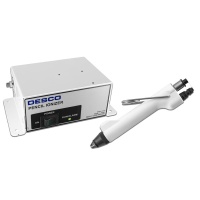
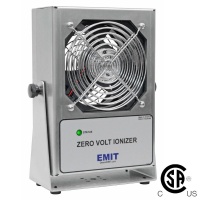
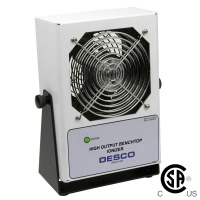
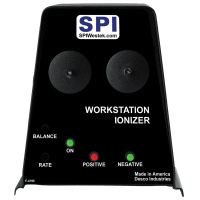
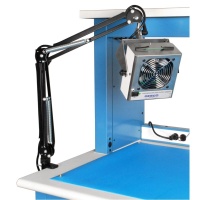
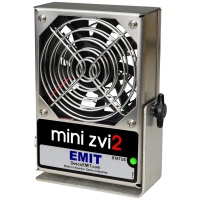
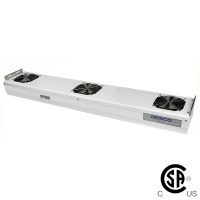
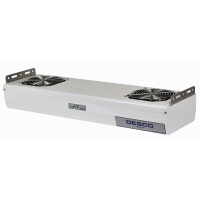
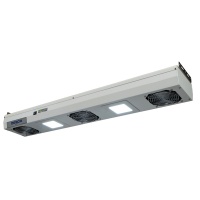
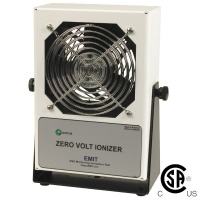
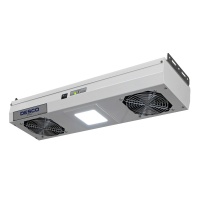
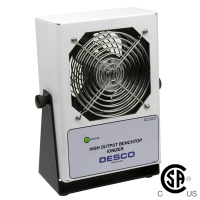
Desco 19520 is a bench top blower ionizer, 220v nist.
This ionizing unit is a self-balancing bench top ionizer. The ionizer's patented (US Patent 5,008,594) Faraday Balance System assures low offset voltage or balance automatically. It offers greater efficiency and easier cleaning than conventional ionizers. The Bench Top Ionizer is designed to neutralize static electricity from insulators and isolated conductors in localized work areas in assembly rooms, wave solder lines, laboratories, QC, test stations, packing and shipping areas and clean rooms.
Ionizers are useful in limiting electrostatic charge generation, ElectroStatic Discharge, and ElectroStatic Attraction, as well as preventing equipment latch-up. ANSI/ESD S20.20 Paragraph 6.2.3.1 Protected Areas Requirement states: "Ionization or other charge mitigating techniques shall be used at the workstation to neutralize electrostatic fields on all process essential insulators if the electrostatic field is considered a threat." Some examples of process necessary insulators are: the PC board itself, plastic test stands, plastic housing where a PCB may be mounted, as well as computer monitor screens and regular cleaning wipes. Examples of floating or isolated conductors are: loaded PCB mounted in a stand where the pins are not contacting the dissipative workstation. Ionization is not effective on items that have large capacitance, like people and carts; however, ionizers should be considered as a method for charge neutralization in cases where grounding cannot be achieved.
Air ionization can neutralize the static charge on insulated and isolated objects by producing separate charges in the molecules of the gases of the surrounding air. When an electrostatic charge is present on objects in the work environment, it will be neutralized by attracting opposite polarity charges from the ionized air.
Packaging:
1 Bench Top Blower Ionizer
1 Power Cord 6' (19500 only)
1 Cleaning Brush
1 Filter and Guard Assembly
1 Certificate of Calibration
Additional Item of Interest: Desco 19500 Bench Top Blower Ionizer, 120V
US Patent 5,008,594
“Necessary non-conductors in the environment cannot lose their electrostatic charge by attachment to ground. Ionization systems provide neutralization of charges on these necessary non-conductive items (circuit board materials and some device packages are examples of necessary non-conductors). Assessment of the ESD hazard created by electrostatic charges on the necessary nonconductors in the work place is required to ensure that appropriate actions are implemented, commensurate with risk to ESDS [ESD sensitive] items”. (ANSI/ESDS20.20-2007 Foreword)
“In order to mitigate field-induced CDM [Charged Device Model] damage, the ESD program shall include a plan for the handling of process-required insulators. If the field exceeds 2,000 volts/inch, steps shall be taken to either: A) Separate the insulator from the ESD-sensitive device by a distance of 30 cm (12 inches); or B) Use ionization or other charge mitigating techniques to neutralize the charge.” (ANSI/ESDS20.20-2007 section 8.3)
“The primary method of static charge control is direct connection to ground for conductors, static dissipative materials, and personnel. A complete static control program must also deal with isolated conductors that cannot be grounded, insulating materials (e.g., most common plastics), and moving personnel who cannot use wrist or heel straps or ESD control flooring and footwear. Air ionization is not a replacement for grounding methods. It is one component of a complete static control program. Ionizers are used when it is not possible to properly ground everything and as backup to other static control methods. In clean rooms, air ionization may be one of the few methods of static control available.” (ESD Handbook TR20.20 Ionization, section 5.3.6.1)
“All ionization devices will require periodic maintenance for proper operation. Maintenance intervals for ionizers vary widely depending on the type of ionization equipment and use environment. Critical clean room uses will generally require more frequent attention. It is important to set-up a routine schedule for ionizer service. Routine service is typically required to meet quality audit requirements.” (ESD Handbook TR 20.20 section 5.3.6.7 Maintenance / Cleaning)